What Does an ERP Implementation Partner Do? (Beginner-Friendly Guide)

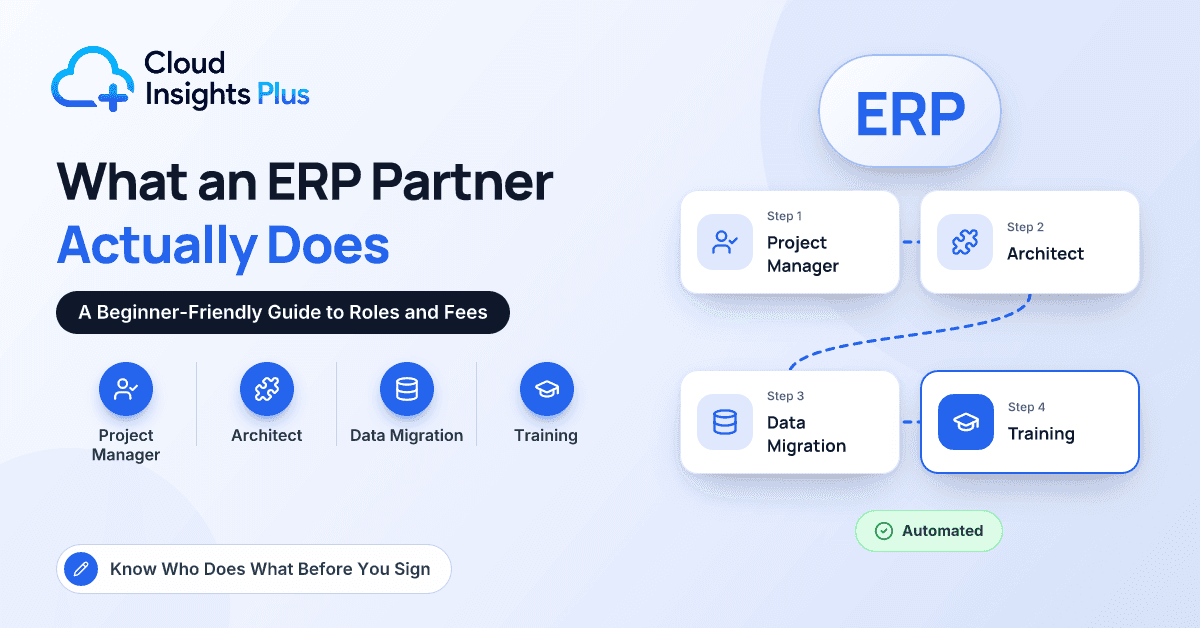
You've chosen your ERP software, and the vendor has introduced you to "your implementation partner." A few days later a kickoff invitation arrives listing a project manager, a solution architect, three consultants and a data migration specialist. You realize you don't know what most of these people will actually do, or what they'll expect from you.
That's completely normal. Most companies replace their ERP system once every ten or fifteen years, so few people inside the business have been through it before. The partner, by contrast, does it all the time. Understanding how their team works is the quickest way to become a confident customer rather than a passenger on your own project.
This beginner-friendly guide is for first-time ERP buyers at small and mid-size companies, especially manufacturers and distributors. We explain what an implementation partner is, introduce each role on a typical partner team, walk through what they deliver in each phase, spell out what your company still has to own, and explain how partner engagements are usually priced.
What Is an ERP Implementation Partner?
An ERP implementation partner is a consulting firm that a software vendor has authorized and trained to configure, extend and roll out its product for customers. Microsoft, SAP, Oracle NetSuite, Acumatica and others rely heavily on partner networks, particularly for small and mid-size customers. For some products, including Business Central and SAP Business One, partners handle almost every implementation.
The vendor builds and maintains the software. The partner turns it into a working system for your business: configured for your processes, loaded with your data, connected to your other applications and understood by your people. If you want the full picture of how licensing, hosting and support split between the two, see our guide to ERP partner vs ERP vendor.
Who Is on a Typical ERP Partner Team?
Team size depends on the project. A small cloud ERP rollout might involve three or four people, some of them part-time, while a multi-site manufacturing program can involve a dozen or more. The roles, though, are remarkably consistent.
Project Manager
The project manager owns the plan, budget, risks and status reporting. They coordinate the partner's people, run weekly status meetings, prepare steering committee updates and manage change requests when scope shifts. Their counterpart on your side is your internal project manager, and the relationship between those two people sets the tone for the whole project.
Solution Architect
The solution architect is the design authority. They decide how the system will meet your requirements end to end: which modules to use, how legal entities and the chart of accounts are structured, where integrations connect, and whether each gap is solved by configuration, an add-on or custom code. On smaller projects, a senior lead consultant often plays this role.
Functional Consultants
These are the people you'll spend the most time with. Each specializes in an area: finance (general ledger, payables, receivables, fixed assets, consolidation), supply chain (purchasing, inventory, warehousing), manufacturing (bills of materials, routings, MRP), or projects. They run design workshops with your process owners, configure the system, write test scripts and usually train your key users.
Developers and Technical Consultants
Developers build what configuration can't deliver: extensions, custom reports, integrations and automated workflows. On cloud ERP they work within the vendor's supported extension model, such as AL for Business Central or SuiteScript for NetSuite, so customizations survive vendor updates. Technical consultants also set up environments, security roles and system connections.
Data Migration Specialist
This person designs the migration templates and tools, maps fields from your old system to the new one, runs trial loads and produces reconciliation reports. They won't clean your data (that's your job), but they will show you exactly where the problems are, from duplicate customers to items with missing units of measure.
Trainer or Change Lead
The trainer prepares materials and sessions, often using a "train the trainer" approach in which your super-users learn first and then coach their colleagues. On larger projects, a change management lead also plans communications and checks that each department is ready before go-live.
| Role | What they do | When you'll work with them most |
|---|---|---|
| Project manager | Plan, budget, risks, status, change requests | Every week, start to finish |
| Solution architect | Overall design and key technical decisions | Discovery and design |
| Functional consultants | Workshops, configuration, test scripts, key-user training | Design through go-live |
| Developers | Extensions, reports, integrations, workflows | Build and testing |
| Data migration specialist | Templates, mapping, trial loads, reconciliations | Build through cutover |
| Trainer or change lead | Training materials, super-user coaching, readiness | Testing through go-live |
What Does the Partner Deliver in Each Phase?
Methodologies differ by vendor and firm. SAP projects typically follow SAP Activate, Microsoft publishes its Success by Design guidance for Dynamics 365, and many partners have their own variation. Most follow a similar arc, and our article on ERP implementation stages covers the phases in depth. For a beginner, the useful question is what you should actually receive at each stage:
- Discovery and planning: a project charter, scope statement, plan, responsibilities matrix and risk log. Some partners run a short paid discovery that ends with a firm estimate.
- Design: process workshops and a solution design document (sometimes called a fit-gap analysis) describing how each process will run in the new system and where gaps remain, plus designs for integrations and data migration.
- Build and configuration: a configured test environment, extensions and integrations, migration templates and security roles. Many partners show progress through regular walkthroughs so you see the system taking shape.
- Testing: test scripts, system and integration testing, support during your user acceptance testing, and a defect log with fixes.
- Training and cutover: training materials and sessions, a detailed cutover plan for the final data load and switch-over, and a go/no-go checklist, ideally after a rehearsal.
- Go-live and hypercare: hands-on support in the first weeks, help with the first month-end close, and a structured handover to whoever will provide ongoing support.
What Does Your Company Still Own?
This is the part first-time buyers most often underestimate. A partner can configure the software, but it can't run your business. Your company still owns:
- Decisions. How processes will work, who approves what, how the chart of accounts is structured. The partner recommends; you decide.
- Data. Cleansing records, deciding what history to migrate, validating each trial load and signing off the reconciliations.
- People. An internal project manager, a process owner for each area, super-users in every department, and backfill so they have time for the project.
- User acceptance testing. Your staff, testing your real scenarios with your migrated data.
- Change. Explaining why the company is changing, setting expectations and retiring old spreadsheets and workarounds.
- Third parties. Banks, EDI trading partners and other software vendors whose cooperation integrations depend on.
Pro tip: Ask the partner to include a responsibilities matrix in the statement of work that lists, task by task, who does the work, who approves it and who must be consulted. Most disputes later in a project trace back to an assumption nobody wrote down.
How Are ERP Partner Engagements Priced?
Partners typically use one of a few commercial models, sometimes in combination.
Time and materials. You pay hourly or daily rates by role for the time actually spent. It's flexible and suits projects where scope is still uncertain, but the budget risk sits with you, so insist on a detailed estimate and regular reports showing hours used against plan.
Fixed fee. The partner commits to a price for a defined scope and carries the overrun risk, which is usually priced into the quote. Anything outside that scope becomes a change order, so a precise scope document is essential.
Phased or hybrid. A common, sensible middle ground: a fixed-price discovery phase, followed by a fixed or capped estimate for the rest once requirements are clear.
Packaged implementations. Some partners offer preconfigured "rapid" packages for small businesses with clearly defined limits on scope, users and integrations. They're faster and cheaper but less flexible.
Ongoing support. After go-live, support is usually sold as a block of prepaid hours, a monthly retainer or a managed services agreement with service levels.
As a broad guide, partner fees for a small business implementing a cloud ERP commonly run into the tens of thousands of dollars, while mid-market projects with manufacturing, multiple entities or heavy integration often reach well into six figures. Rates vary by region, product and seniority, so check current pricing with partners. Software licenses are usually billed separately, even when you buy them through the same partner.
Conclusion
An ERP implementation partner brings a team of specialists (a project manager, solution architect, functional consultants, developers, a data migration specialist and a trainer) who turn packaged software into a system that runs your business. They deliver tangible outputs in every phase, from a solution design to a cutover plan. But your company still owns the decisions, the data, the testing and the people side of change, and the commercial model you agree determines who carries the budget risk.
When you're ready to evaluate firms, our ERP partner checklist for decision makers explains what to look for, and our partner directory lets you compare implementation partners by platform, industry and company size.
Frequently Asked Questions
Do I need an implementation partner, or can the vendor implement the ERP?
It depends on the product. Some vendors, such as Oracle NetSuite, offer their own implementation services alongside partners, while products like Business Central and SAP Business One are implemented almost entirely by partners. Very small, simple deployments can sometimes be done in-house, but most companies benefit from experienced help.
How many people will the partner assign to my project?
A small cloud ERP project might involve three or four partner staff, several of them part-time, while a complex multi-site program can involve a dozen or more. What matters more than headcount is that the key people are named, committed for a stated share of their time, and stay with your project from design to go-live.
What is the difference between a functional and a technical consultant?
A functional consultant focuses on business processes and how the system is configured to support them, such as how purchase approvals or inventory costing work. A technical consultant or developer focuses on code, integrations, data and infrastructure. Most projects need both, working closely together.
Does the partner stay involved after go-live?
Usually, yes. Most partners provide a hypercare period of intensive support straight after go-live, then offer ongoing support through prepaid hours, a retainer or a managed services agreement. Agree the post-go-live arrangement before you sign the implementation contract rather than afterward.
Why do some partners charge for discovery?
A paid discovery phase lets the partner study your processes properly before committing to a price for the full project. It typically produces a clearer scope and a more reliable estimate, which protects both sides. A partner willing to quote a firm price without any discovery is often relying on assumptions you haven't seen yet.