Top Benefits of Working with a Certified SAP Partner

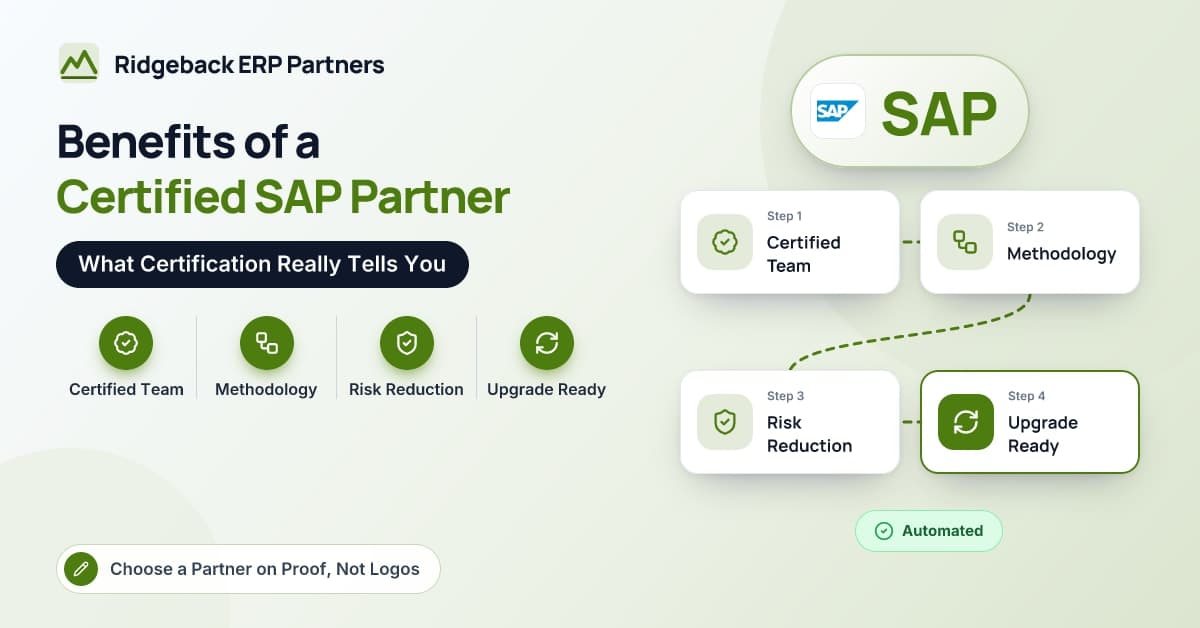
Line up three SAP partner proposals and you'll find the same words on the first page of each: certified consultants, an SAP partner logo, a proven methodology. They read like differentiators. Usually they aren't, because every credible SAP partner can claim them.
That doesn't make certification meaningless. It means buyers need to know what it actually signals, what it doesn't, and how to tell a firm that holds the credentials from a firm that will deliver your project well.
We're in a slightly unusual position to talk about this. Ridgeback ERP Partners implements SAP Business One and SAP S/4HANA Cloud Public Edition, and we also implement Microsoft Dynamics 365 Business Central, so much of our work starts with selection rather than an assumption that SAP is the answer. This article is for owners, CFOs and IT leads at mid-market distributors and manufacturers who have SAP on the shortlist. We'll explain the two kinds of certification, the concrete benefits of working with a certified SAP partner, and the limits of certification on its own.
What Does "Certified SAP Partner" Actually Mean?
The phrase blends two different things: certifications held by individual consultants, and the firm's status in SAP's partner program. For a broader look at the types of SAP partners and what they do across the lifecycle, see this beginner-friendly guide to what an SAP partner does.
Consultant Certifications
SAP certifications are exams individuals pass to demonstrate knowledge of a specific product area, such as finance in S/4HANA Cloud Public Edition, sales and distribution, or SAP Business One implementation. They come in levels (broadly associate, specialist and professional) and are tied to products and releases. For cloud products in particular, SAP expects certified consultants to keep their credentials current as the software changes, so a current certification reflects knowledge of a reasonably recent version.
SAP issues certifications as verifiable digital badges, so you can confirm them rather than take a résumé's word for it.
Partner Program Status
SAP PartnerEdge is SAP's partner program. Firms join under models that reflect what they do, such as reselling licenses, building solutions or delivering services, and they can progress through status levels and earn solution- or industry-specific recognition based on criteria such as certified headcount and customer success. To resell and implement many SAP products, a partner typically has to maintain a minimum number of certified consultants for that solution.
In short, consultant certification tells you about individuals' knowledge, and partner status tells you about the firm's standing with SAP. Neither tells you how a specific team will perform on your project.
What Are the Top Benefits of Working with a Certified SAP Partner?
1. A Proven Implementation Methodology
Certified partners deliver SAP projects using SAP Activate, SAP's methodology built around six phases (Discover, Prepare, Explore, Realize, Deploy, Run) and fit-to-standard workshops, where you walk through SAP's standard processes in a working system and identify genuine gaps instead of writing requirements from scratch. This phase-by-phase guide to ERP implementation stages maps SAP Activate to generic ERP phases.
2. Best-Practice Content You Don't Pay to Reinvent
SAP Best Practices provide preconfigured business processes, known as scope items, with process flows and test scripts. In S/4HANA Cloud Public Edition, this content is the foundation of the system. A certified team knows how to start from it, which shortens design and reduces the temptation to rebuild processes SAP has already designed well.
3. Licensing Guidance That Fits Your Size
SAP's commercial options can be confusing: RISE with SAP, typically used for larger S/4HANA transformations; GROW with SAP, aimed at midsize companies adopting S/4HANA Cloud Public Edition; and SAP Business One, with its own user types for smaller firms. An experienced partner helps you choose the right offering and license mix, so you're neither paying for user types you don't need nor under-licensing in a way that causes compliance problems later.
4. A Direct Line Into SAP Support
Partners have access to SAP's support channels and know how to log, prioritize and escalate incidents effectively. For SAP Business One, the partner usually provides first-line support and escalates product issues to SAP, so the quality of that relationship directly affects how quickly problems get resolved.
5. Early Visibility Into Releases and the Roadmap
Partners receive release information and enablement ahead of general availability. That matters most in the public cloud, where SAP updates the system on its own schedule and your partner needs to have assessed new features and changes before they reach production.
6. Upgrade Readiness and a Clean Core
SAP's guidance is to keep the core system as close to standard as possible and build extensions outside it, using key-user tools, released APIs and SAP Business Technology Platform (BTP). Certified consultants know which extension techniques are supported in which edition. That discipline is what keeps future upgrades routine rather than turning them into re-implementations.
7. Integration Done the Supported Way
Connecting SAP to e-commerce, EDI, CRM, banking and warehouse systems is often where projects run long. A certified partner uses supported interfaces, such as released APIs and SAP Integration Suite in the S/4HANA world, or the Service Layer and DI API for SAP Business One, instead of fragile direct-database workarounds.
8. Lower Delivery Risk
Teams that know the standard product well propose fewer custom developments, recognize which requirements are genuine gaps, and spot design decisions that will cause trouble six months after go-live. In our own projects, the most expensive problems almost always trace back to early decisions made without that knowledge.
9. Continuity After Go-Live
A certified partner that keeps its people current can help you adopt new features each release, train new staff, and support organizational changes such as a new legal entity or an acquisition.
What Are the Limits of Certification Alone?
Here's where we'd encourage healthy skepticism.
| Signal | What it tells you | What it doesn't tell you | How to check |
|---|---|---|---|
| Consultant certification | The person passed an exam on a specific product area and release | Whether they've led projects like yours | Ask for project histories, not just badges |
| Partner status level | The firm's standing in SAP's program | Delivery quality; status can reflect sales volume as well as capability | Ask for references at your size and in your industry |
| Solution authorization | The firm can resell and implement that product | Depth of experience on your specific edition | Ask how many recent go-lives they've had on your edition |
| Certified headcount | The firm has qualified people somewhere | Whether those people will be on your project | Name key team members in the statement of work |
| Industry recognition | A track record in a vertical | Fit with your specific processes | Run a scripted demo with your own scenarios |
Two more limits are worth stating plainly. Certification in one SAP product doesn't transfer to another: deep S/4HANA private cloud experience doesn't make someone an SAP Business One expert, or vice versa. And certification says nothing about neutrality. A single-vendor SAP partner will, understandably, recommend SAP. If you haven't yet confirmed SAP is the right platform, settle that question before choosing an implementer.
Key takeaway: Treat certification as a minimum qualification, not a deciding factor. The deciding factors are the named team, relevant references and how the partner handles your real scenarios.
How Do You Verify a Partner's Certifications and Fit?
A short checklist we'd use ourselves:
- Ask for the names and certification badges of the consultants proposed for your project, and confirm they're current for your product and release.
- Confirm which SAP product and edition the partner is authorized for and has recently taken live.
- Request two or three references from companies of similar size and industry, and ask them about the team that delivered, not just the outcome.
- Ask how the partner handles support escalation to SAP and what response times they commit to.
- Ask how they keep certifications current as releases change.
For a fuller treatment of the selection process, see how to choose the right SAP implementation partner. You can also compare firms in the SAP partner directory.
Conclusion
Working with a certified SAP partner brings real advantages: a proven methodology, preconfigured best-practice content, sensible licensing advice, a direct route into SAP support, and the discipline to keep your system upgradeable. Those benefits are worth having.
But certification is the start of due diligence, not the end of it. Verify the credentials, insist on a named team, check references at your scale, and test the partner on your own scenarios before you sign.
If you'd like an even-handed view on whether SAP is the right fit, and which kind of partner suits your business, Ridgeback ERP Partners is always glad to talk.
Frequently Asked Questions
What is a certified SAP partner?
It usually means a firm that belongs to SAP's PartnerEdge program, is authorized for specific SAP products, and employs consultants who hold SAP certifications in those products. The exact meaning varies, so ask which products the firm is authorized for and which consultants hold which certifications.
Do SAP certifications expire?
SAP expects certifications for its cloud products to be kept current as new releases arrive, and a certification that isn't maintained can lapse. The details vary by certification, so ask partners how they keep their teams up to date and check that badges are current.
Is a higher SAP partner status always better?
Not necessarily. Higher status can reflect sales volume as well as delivery capability, and a large partner may assign its most experienced people to its largest clients. A smaller partner focused on your industry and edition can be a better fit for a mid-market project.
Can I buy SAP directly instead of through a partner?
It depends on the product. SAP Business One is sold and supported through partners, while larger S/4HANA agreements may be contracted directly with SAP. Even then, implementation work is typically delivered by partners, so you'll almost always be choosing one.
How many certified consultants should a partner have?
There's no magic number. What matters is that the people proposed for your key roles, such as the solution architect and the finance and logistics leads, hold current certifications in your product and have delivered similar projects. A smaller certified team that will actually staff your project beats a larger one whose certified people are elsewhere.