How to Choose the Right ERP Partner – Checklist for Decision Makers

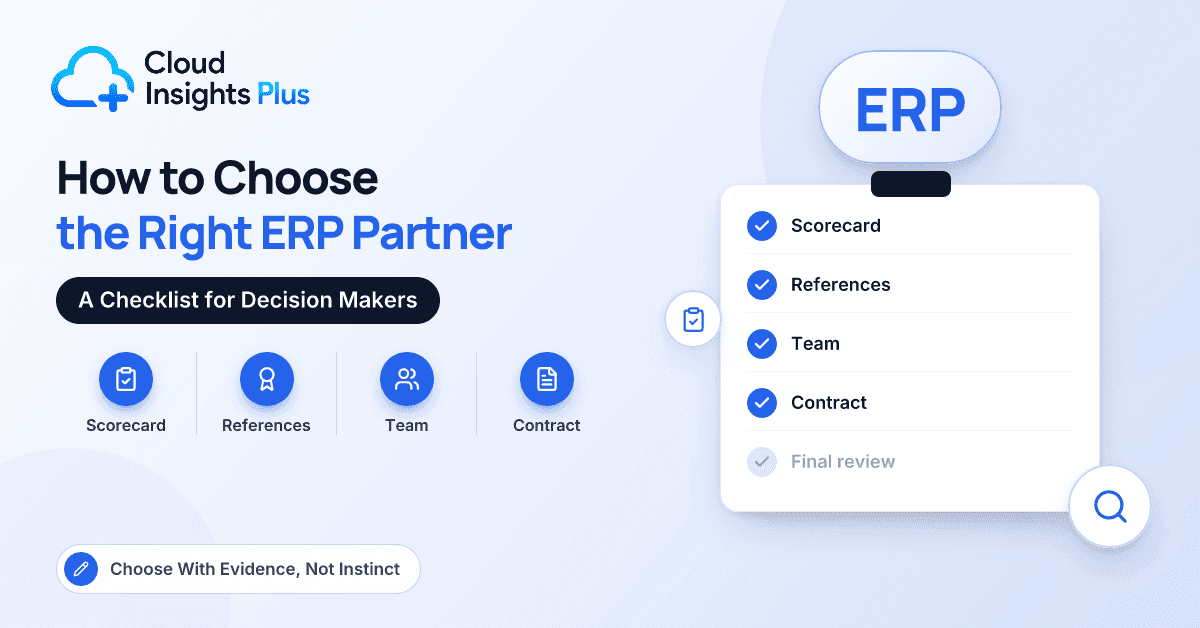
Ask executives who have lived through a difficult ERP project what they would do differently, and many won't mention the software at all. They'll mention the partner: the senior architect who vanished after the pitch, the estimate that doubled once the "assumptions" surfaced, the firm that had never configured a process like theirs.
Your implementation partner shapes the plan, the staffing, the design decisions and, ultimately, whether people can do their jobs on the first day after go-live. Yet partner selection is often squeezed into a couple of meetings at the end of a long software evaluation, and decided on day rate or chemistry.
This checklist is for CEOs, CFOs, COOs and IT leaders who will sign off on the choice. It is vendor-agnostic and works just as well for Business Central, NetSuite, SAP, Acumatica or any other platform. You'll get a weighted scorecard, a practical evaluation process, the contract terms that protect you, and the red flags that should end a conversation early.
Why Should Executives Own the Partner Decision?
Because choosing a partner is a risk decision, not a procurement exercise. The partner's estimate becomes your budget. Its team makes or shapes hundreds of design choices. Its method determines how much of your best people's time the project consumes, and its support model decides how quickly problems get fixed after go-live.
Executives don't need to judge technical detail, but they should own the criteria, the weights and the final call, and make sure the evaluation follows the evidence. If you're new to how partner teams work, our beginner's guide to what an ERP implementation partner does explains the roles you'll be evaluating.
What Should an ERP Partner Scorecard Include?
A weighted scorecard turns a subjective choice into a structured comparison. Here is a starting template with seven criteria:
| Criterion | Weight | What good looks like | Evidence to request |
|---|---|---|---|
| Fit (product, industry, size) | 20% | Repeated recent delivery for companies like yours | Project list filtered by industry, size and product |
| Team | 20% | Named senior people who will do the work | CVs, tenure, certifications, committed availability |
| References | 15% | Recent, comparable, candid customers | Three references, including one difficult project |
| Methodology | 15% | Documented, phase-gated, scaled to your size | Sample plan, deliverables and test approach |
| Commercials | 15% | Transparent estimate with explicit assumptions | Estimate by phase and role, rate card, change process |
| Support | 10% | Clear post-go-live model with service levels | Support agreement, SLAs, escalation path |
| Culture | 5% | Candid, collaborative, willing to push back | Behavior observed in workshops and orals |
Adjust the weights to your situation. A manufacturer with complex production might raise Fit, while a company with a thin internal team might raise Methodology and Support. Whatever you choose, agree the weights before you meet any partner; changing them afterward usually rationalizes a favorite. Have each evaluator score 1–5 independently before discussing, and treat a score of 1 on Fit, Team or References as a knockout regardless of the total.
Fit
- Has the partner implemented this product, in a comparable deployment, for companies of your size and industry within the last few years?
- Do they bring industry templates or add-ons rather than starting from a blank system?
- Would you be a typical client for them, neither their largest nor their smallest?
Team
- Are the proposed consultants named, and will they attend the final presentation?
- What share of each person's time is committed to your project, and for how long?
- What happens, contractually and practically, if a key person leaves?
References
- Speak to at least three customers, including one live for more than a year.
- Ask for a project that went badly and how the partner responded.
- Ask each reference how the final cost and timeline compared with the original estimate.
Methodology
- Can they show the deliverables and exit criteria for each phase?
- Who does what in data migration and testing, specifically?
- How are change requests raised, priced and approved?
Commercials
- Is the estimate broken down by phase and role, with assumptions listed?
- Which risks sit with you and which with the partner under the proposed model?
- Are project management, travel and post-go-live support included or extra?
Support and Culture
- Is there a defined support model with hours, service levels and escalation?
- How do they handle the vendor's regular updates for cloud products?
- Did they challenge any of your assumptions during the evaluation, and explain trade-offs in plain language?
How Should You Run the Partner Evaluation?
A disciplined process takes several weeks, and rushing it to protect a go-live date is false economy. A typical sequence looks like this:
- Build a shortlist of three or four partners for your chosen product, or two per product if the software decision is still open. Draw on peer referrals, vendor partner listings and our partner directory.
- Send a concise briefing pack. Ten to fifteen pages covering your company, scope, key processes, integrations, data volumes, timing, budget range and evaluation criteria usually beats a hundred-page RFP.
- Hold scoping sessions. Give each partner a few hours with your process owners. The quality of their questions tells you as much as their answers.
- Request proposals in a common format: approach, named team, plan, and an estimate by phase with assumptions, so you can compare like with like.
- Run orals with the delivery team. The people who will do the work present, and you give them a live scenario from your business to work through.
- Check references independently and record what you hear against the scorecard.
- Score, calibrate and negotiate with your top two before making a final decision.
If you're evaluating partners for a specific platform, our platform checklists go deeper on what to look for in a Dynamics 365 partner and an SAP implementation partner.
What Must Be in the Contract?
Your legal team will review the terms, but executives should confirm the commercial protections are there. Before signing, check that the agreement includes:
- A statement of work listing what is in scope, what is out of scope, the deliverables in each phase and every assumption the estimate depends on
- Acceptance criteria for each deliverable, with milestone payments tied to acceptance rather than the calendar
- Named key personnel, your approval rights over substitutions and a notice period for any change
- A change control process with defined rates and approval thresholds
- A responsibilities matrix stating who cleanses data, who writes and runs tests, and who trains users
- A rate card fixed for the life of the project and the first period of support
- A warranty period for defects in partner-built work, plus a defined hypercare period after go-live
- Ownership or licensing terms for custom code, configuration and documentation
- Termination and transition assistance, including handover of code, documentation and system credentials
- Data protection, security and insurance obligations appropriate to the data the partner will access
What Are the Red Flags?
Any one of these deserves a hard question. Two or three together are usually a reason to walk away.
- The sales team won't name the delivery team, or the names change between proposal and orals.
- The estimate is far below the others with no clear explanation; the gap is usually hidden in assumptions that shift work back to you.
- The partner agrees to every requirement without discussing cost, risk or standard alternatives.
- References are old, from much larger or smaller companies, or from a different industry.
- Answers about data migration ownership and testing are vague.
- There's pressure to sign quickly in exchange for a discount.
- Heavy customization is proposed before anyone has studied your processes.
- Support after go-live is undefined or treated as an afterthought.
Key takeaway: Decide your criteria and weights before you meet any partner, insist on meeting the people who will actually do the work, and make the contract reflect what you were promised in the sales process. A partner who is confident in their team and estimate will rarely resist any of these.
Conclusion
Choosing an ERP partner well comes down to evidence. A weighted scorecard covering fit, team, references, methodology, commercials, support and culture keeps the decision objective. A structured evaluation, with scoping sessions and orals led by the delivery team, shows you how each firm really works. A contract with named personnel, acceptance criteria, change control and transition rights protects you if things change. And a short list of red flags tells you when to walk away.
To build your shortlist, browse our partner directory or go straight to the SAP, Microsoft Dynamics 365, Salesforce or HubSpot listings, then compare partners by industry, region and company size.
Frequently Asked Questions
How many ERP partners should we evaluate?
Three or four is usually right for a single product. Fewer limits your comparison and negotiating leverage, while more stretches your team's time and makes scoring harder. If you're still choosing between two products, two partners per product works well.
Should we choose the ERP partner before or after the software?
Most companies narrow the software to two or three finalists first, then evaluate partners for those products before signing anything. Choosing them together matters because a partner's industry experience can make one product the better choice in practice, even if the demos scored similarly.
Is the cheapest ERP partner proposal ever the right choice?
It can be, if the scope, team and assumptions are genuinely comparable. More often, a much lower price reflects a thinner team, more junior consultants or assumptions that move work back to you. Compare proposals line by line before treating price as the deciding factor.
Should we use a formal RFP to select an ERP partner?
A short, focused briefing pack usually works better than a long RFP. Partners give more useful responses when they understand your processes, priorities and constraints, and scoping sessions reveal far more about a firm than written answers. Keep formal RFPs for situations where procurement rules require them.
Can we change ERP partners in the middle of a project?
Yes, but it's disruptive and costly, so it should be a last resort after a frank escalation and recovery plan. If you do switch, the new partner will need time to review the existing design and build, which is why transition assistance clauses and full documentation in the original contract matter.