Logistics & Warehouse Automation Trends in the USA

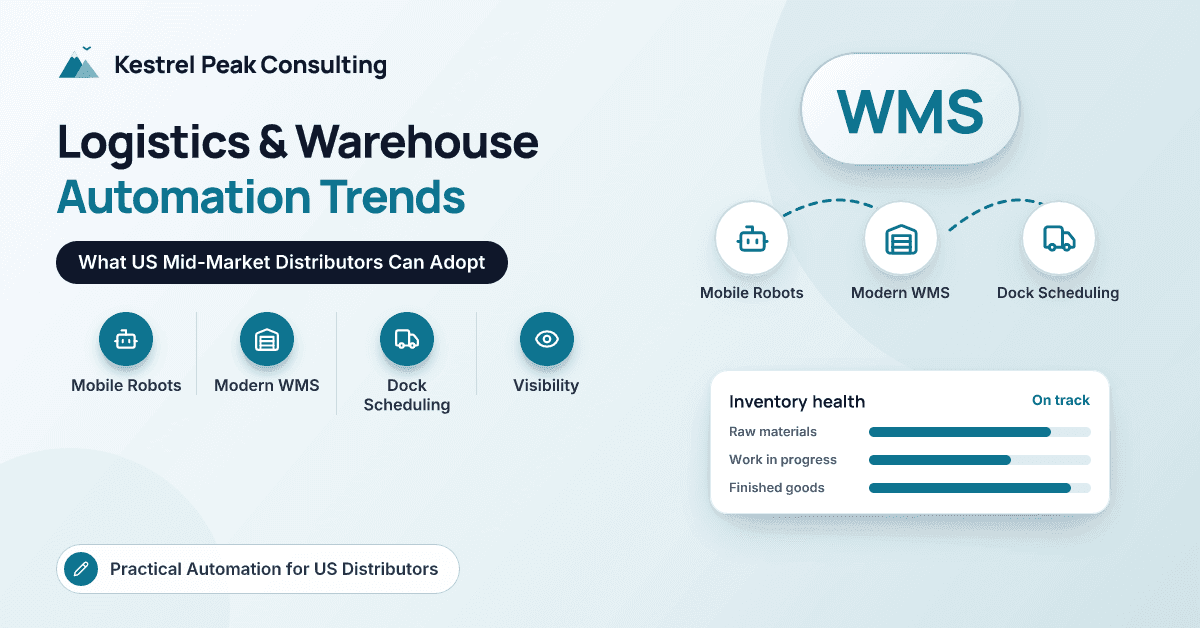
Walk the floor at any US logistics trade show and the message is hard to miss: fleets of mobile robots, towering storage grids, conveyor systems that sort thousands of cartons an hour. Then walk into a typical mid-market distribution center in Denver, Omaha or Salt Lake City. You will often find RF scanners, paper pick lists for the awkward SKUs, a whiteboard dock schedule, and an inventory figure in the ERP that the warehouse manager does not quite trust.
Both pictures are real. For a distributor or manufacturer with one to five facilities, the question is not whether warehouse automation is coming. It is which pieces suit a business of your size, and in what order.
At Kestrel Peak Consulting we work with mid-market manufacturers and distributors on SAP S/4HANA and the systems around it, including warehouse management and plant-floor integration. This article covers the logistics and warehouse automation trends shaping the US market: mobile robots, goods-to-person systems, WMS modernization, labor constraints, reshoring, yard and dock automation, visibility platforms and ERP–WMS integration. For each, we give a realistic view of what a mid-market operation can adopt now.
What Is Driving Warehouse Automation in the US?
Three pressures are pushing at once. Labor is the first: warehouse roles are hard to fill and harder to keep, peak seasons strain temporary staffing, and physically demanding work carries injury and turnover costs. Customer expectations are the second. Orders are smaller and more frequent, delivery windows are tighter, and B2B buyers increasingly expect the tracking visibility they get as consumers. The third is network change, as more sourcing and production moves into the US and nearby countries.
Meanwhile, the technology has become easier to buy. Robots are offered on subscription, warehouse software runs in the cloud, and storage systems come in modular sizes. The entry point is lower than it was even a few years ago, which is why these conversations have reached companies that would never have considered automation before.
What Are the Key Logistics and Warehouse Automation Trends?
1. Autonomous Mobile Robots
Autonomous mobile robots (AMRs) navigate using sensors and onboard maps, unlike older automated guided vehicles (AGVs) that follow fixed paths. The most common mid-market use is collaborative picking: robots carry totes through the aisles while pickers stay in their zones, which cuts walking. AMRs also move goods between receiving, putaway and staging. Many vendors offer robots-as-a-service pricing, turning a capital purchase into an operating expense. The prerequisites are less glamorous: accurate location data, a WMS that can hand tasks to the robots, and reliable wireless coverage.
2. Goods-to-Person Systems
Goods-to-person systems bring inventory to a stationary picker instead of sending the picker to the shelf. The range runs from large automated storage and retrieval systems (AS/RS) and shuttle systems to cube-based grid storage, vertical lift modules (VLMs) and carousels. For mid-market operations, VLMs for small, high-value parts and modular cube systems for high-SKU each-picking are the most realistic options. The gains are density and pick accuracy; the trade-offs are capital cost, throughput ceilings and dependence on one piece of equipment.
3. WMS Modernization
Many mid-market sites still run on basic ERP inventory management with simple bins, or on an aging on-premise WMS. A modern warehouse management system adds directed putaway, dynamic picking, task interleaving, slotting, cartonization, labor management, mobile interfaces and connections to automation equipment. Options include warehouse management embedded in the ERP, such as SAP Extended Warehouse Management in S/4HANA, a decentralized WMS instance, or a cloud best-of-breed WMS. Our view is simple: the WMS is the foundation. Automation layered on paper processes is expensive disappointment.
4. Labor Constraints and the Augmented Workforce
Labor is why automation is on the agenda, but the dominant trend in mid-market warehouses is augmentation rather than replacement. Voice picking, pick-to-light, wearable scanners, ergonomic lift assists, engineered labor standards and multilingual mobile screens all make existing teams more productive and shorten training time for new hires. They also make jobs physically easier, which helps retention.
5. Nearshoring and Reshoring
More production is moving to the US and Mexico, shortening lead times but changing freight patterns. Distributors see more cross-border truck freight, more frequent and smaller replenishments, and more demand for value-added services such as kitting and light assembly. That puts pressure on dock capacity, country-of-origin and trade-compliance data, and the ability to receive mixed loads quickly. It also changes where networks need buildings, with more interest in the Southwest and Midwest.
6. Yard and Dock Automation
The dock is often the hidden bottleneck. Carrier appointment scheduling, yard management systems that track trailer locations and dwell time, and automated gate check-in using cameras and license-plate recognition are all practical at mid-market scale. Automated trailer loading and unloading exists, but remains an early-adopter technology for most.
7. Real-Time Visibility Platforms
Visibility platforms combine carrier telematics, electronic logging device data, EDI and API status messages and IoT trackers to predict arrival times and flag exceptions. The value comes when those ETAs feed the dock schedule and customer notifications, not when they sit on another screen nobody watches. AI-driven ETA prediction and demand sensing are covered in more depth in AI in supply chain management with ERP.
8. ERP–WMS Integration as the Backbone
Every trend above depends on the ERP and WMS agreeing on the data: item master (dimensions, weights, units of measure, pack hierarchies), inventory status, lots and serials, advance ship notices, order release and confirmations. Decide the system of record early. Typically the ERP owns financial inventory value and the order, while the WMS owns location and task. The most common failures we see are unit-of-measure mismatches, missing item dimensions and inconsistent batch status, none of which a robot can fix. For manufacturers, the same discipline applies to the plant floor, as we discuss in ERP for manufacturing.
Which Trends Can Mid-Market Distributors Realistically Adopt?
| Trend | Mid-market readiness | Typical first step |
|---|---|---|
| ERP–WMS integration | Prerequisite | Clean the item master and agree the system of record |
| WMS modernization | Ready now | Replace paper and basic bins with directed tasks |
| Labor augmentation | Ready now | Mobile or voice picking plus labor standards |
| Yard and dock automation | Ready now | Carrier appointment scheduling |
| Visibility platforms | Ready for key lanes | Feed top carriers' ETAs into the dock schedule |
| Autonomous mobile robots | Pilot-ready | One pick zone on a subscription model |
| Goods-to-person | Selective | A VLM for small, high-value parts |
| Full AS/RS or automated loading | Usually later | Feasibility study tied to a new building |
The sequence matters more than any single technology. Data first, then the WMS, then the dock and visibility, then targeted automation where the process is already stable.
Building a Business Case
Consider a hypothetical distributor running one DC with two shifts of pickers. Suppose time studies show pickers spend much of each shift walking, and the growth plan would require several extra hires within two years. The AMR business case compares the subscription cost against those avoided hires, reduced overtime and less reliance on peak-season temps, plus any accuracy gains. These figures are illustrative; your own time studies and vendor quotes are the only inputs that count. For a structured approach, see how to measure the ROI of digital transformation.
What We Have Learned on Projects
A Midwest industrial distributor came to us with mobile robots already shortlisted. During discovery we found incomplete bin structures, missing dimensions for many items and inventory status that differed between ERP and the warehouse. We spent the first phase on location data, the item master and the integration between S/4HANA and its warehouse management. The robot pilot that followed went smoothly precisely because the data underneath was ready. In another project, simple dock appointment scheduling relieved more congestion at a finished-goods warehouse than any equipment would have.
Key takeaway: For most mid-market US distributors, the best automation investment is the one that makes data trustworthy and processes repeatable. Robots and storage systems pay off when they sit on top of that foundation, not in place of it.
Conclusion
US warehouse automation is moving fast, driven by labor pressure, customer expectations and a shifting supply network. Mobile robots, goods-to-person systems and visibility platforms are real options for mid-market companies, but they work best on a foundation of clean item data, a modern WMS and tight ERP–WMS integration. Start with what is ready now, sequence carefully, pilot before scaling, and build the business case from your own time studies. If you are weighing where automation fits in your warehouse or plant, the team at Kestrel Peak Consulting would be glad to compare notes.
Frequently Asked Questions
What is the difference between an AGV and an AMR?
An automated guided vehicle follows fixed paths, such as magnetic tape or floor markers, and stops when something blocks it. An autonomous mobile robot uses sensors and maps to navigate dynamically around people and obstacles. AMRs are usually quicker to deploy and easier to reconfigure, which suits mid-market warehouses.
Is warehouse automation affordable for mid-size companies?
Increasingly, yes. Subscription pricing for robots, cloud WMS options and modular storage systems have lowered the entry point. The most affordable gains usually come from WMS improvements, mobile picking and dock scheduling before any major equipment purchase.
Do we need a WMS if our ERP has inventory management?
Not always. Basic bin management in ERP can serve a simple operation with modest volumes. Once you need directed putaway, wave or dynamic picking, labor management or integration with automation equipment, a WMS, whether embedded in your ERP or separate, becomes essential.
How does reshoring affect warehouse operations?
Reshoring and nearshoring tend to bring more frequent, smaller replenishments, more cross-border freight and more value-added services such as kitting. That increases pressure on dock capacity, receiving speed and trade-compliance data, so dock scheduling and accurate item data become more important.
What should we automate first in our warehouse?
Start with inventory accuracy and the item master, then modernize WMS processes and the dock. Once processes are stable and measured, pilot targeted automation such as mobile robots in a single zone. Automating an unstable process usually just makes errors happen faster.